

Syllables Are Expensive: What Last Week's Best Sales Minds Said About Winning on Value, Not Price
Five takeaways from last week's top sales podcasts: quantifiable results, visible proof, smarter cold opens, and why price is a lazy excuse.
A rep opens their laptop on Tuesday morning and sends follow-up number four: "Just checking in to see where things stand." No new information. No reason for the buyer to reply. The deal doesn't die in that moment, but it stops moving, and stalled is where most deals actually go to die.
Did you know you can ask our agent for Sales help? Ask our website agent for ‘Sales Help’
That email is a small version of the biggest theme running through last week's sales podcasts (August 3–9): deals are lost in explanation, not negotiation. This briefing synthesizes 90 episodes published across the week; here's what the sharpest voices in sales said, distilled for busy revenue leaders.
1. Buyers only move for a number they can measure
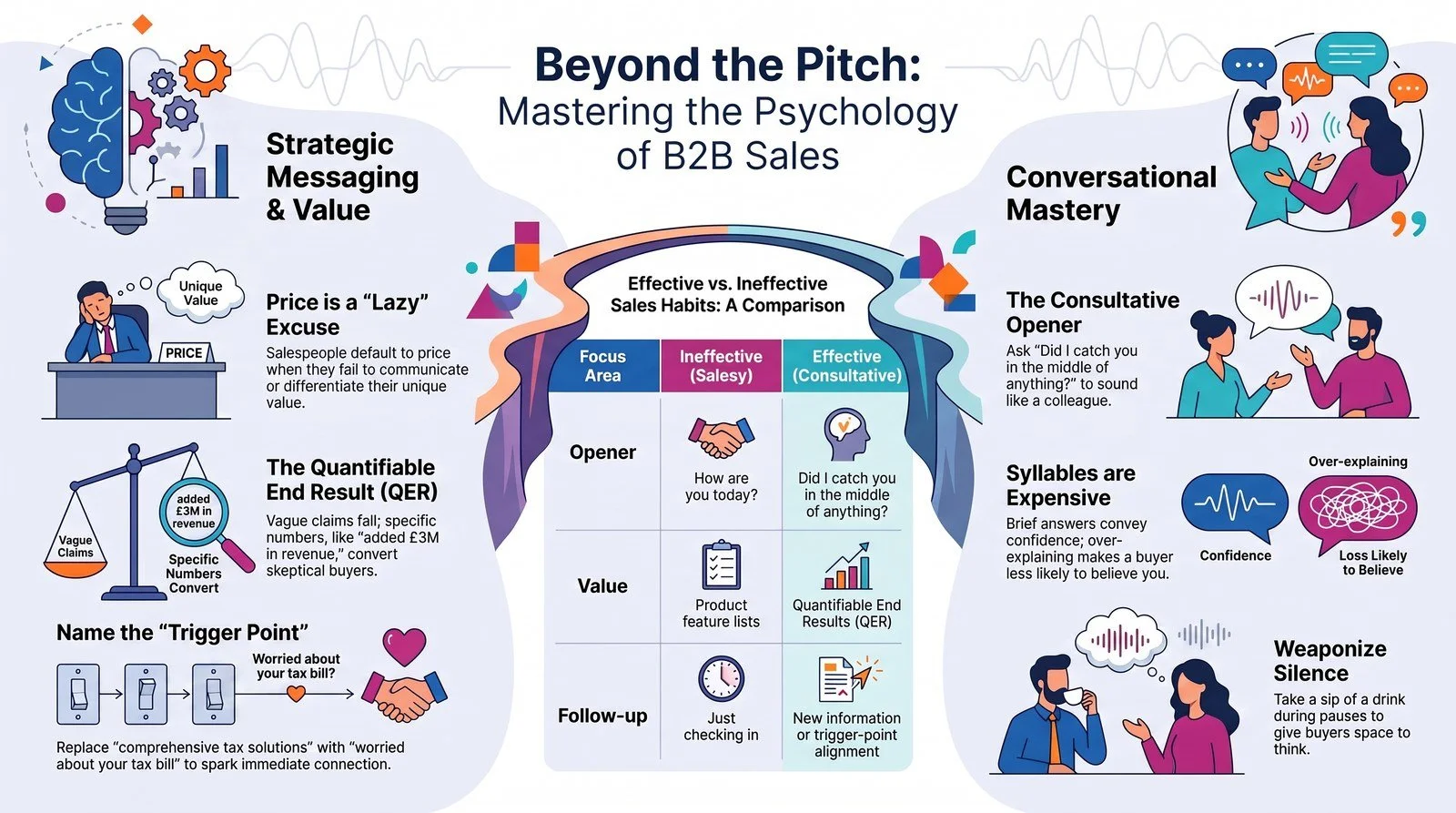
Soft claims are dead weight. "Feel more confident," "streamline your operations," "comprehensive tax solutions" — buyers can't act on any of it because none of it can be measured. What moves a modern buyer is a Quantifiable End Result (QER): "an extra £3 million a year," "15 hours of manual entry saved per week."
The working framework from last week's episodes, verbatim:
"I help [Specific Audience] to [Achieve QER] by [Method/Specific Pivot]."
Audit your own offer for the number hiding inside it. If the end result is invisible, the deal is unclosable.
2. Your proof has to be visible before the first call
B2B buyers now do exhaustive homework before they ever talk to you, and the operating assumption has flipped: any claim they can't verify is assumed to be false. If your evidence lives in a PDF someone has to request, it doesn't exist.
The benchmark cited last week: a seller with 500 LinkedIn recommendations doesn't need to say "we've helped hundreds of companies." The proof is public, countable, and checkable without asking. That's the standard your case studies, reviews, and references are being held to.
One more wrinkle: proof alone isn't enough. Case studies fail when they force the buyer to join the dots. Every piece of proof needs a bridge that answers the four words every buyer is silently asking: "What does this mean for me?"
3. The new cold open sounds like a colleague, not a script
The "honesty play" opener ("Honestly, this is a cold call — can I have 30 seconds?") got a rough grading last week. Transparency buys a moment of goodwill, but it also flags you as a salesperson instantly and triggers the reflexive "we already use someone for that."
The consultative alternative:
Open with "Did I catch you in the middle of anything?" instead of "How are you doing today?" It reads as a colleague peeking into an office, not a script.
Lead with value, not product: "We help decrease your tax exposure," not "We provide tax filing and bookkeeping."
Then take it away: "I don't know if you're a good fit or if we can help you." Expressing doubt right after stating value lowers the buyer's guard and triggers curiosity, because you've signaled you're willing to walk.
4. Price is a lazy excuse
The bluntest line of the week: blaming a lost deal on price is a lazy way of selling. If a company only needed to compete on price, it wouldn't need a sales force — it would need a link.
Three margin-protection rules from the episodes:
Don't start the spiral. Cutting price to beat a competitor begins a race where "everybody's out of business; nobody wins."
Expect churn from price shoppers. Customers who come on price will leave on price.
You are the differentiator. When the product is a commodity, how the salesperson informs, treats, and works with the customer becomes the value chain. Anchor conversations in a hard number (the QER) and the price conversation changes shape.
5. Say less
Two tactical gems on the power of restraint:
The drink trick. When silence lands in a call, take a sip of water or coffee instead of filling the pause. The physical action stops nervous rambling and gives the buyer room to think and respond without pressure.
Syllables are expensive. The more you explain, the less the buyer believes you. Answer questions with surgical brevity; spend your depth on the questions you ask, not the answers you give.
Did you know you can ask our agent for Marketing help? Ask our website agent for ‘Marketing Help’
The "stop doing this" list
Four habits last week's guests want deleted from your team's playbook:
"Checking in" and "touching base" emails. No new information or real trigger point, no send.
Vague "safe" copy. "Comprehensive solutions" and "full suite of services" are invisible to buyers. Name the lived moment instead: "worried about your tax bill."
Manufactured rapport. "How are you doing today?" signals amateur cold call and raises the guard you're trying to lower.
Unproven claims. If the evidence isn't visible without asking, the buyer assumes you're lying.
The metrics that matter this week
QER identification: does every offer contain one specific, quantifiable number?
Proof index: the ratio of publicly verifiable proof points to unverifiable claims.
Trigger-point alignment: are your CRM follow-ups scheduled on arbitrary dates, or tied to new information and real buyer shifts?
Syllable efficiency: your explanation-to-question ratio on calls. High-velocity deals come from brevity in answers and depth in questions.
That third metric is worth an honest look. Open your CRM and check how many scheduled follow-ups exist because a date rolled around versus because something changed for the buyer. For most teams the answer is uncomfortable, and it's also the fastest fix on this list.
Quick quiz: did the briefing stick?
Q: What is a Quantifiable End Result (QER), and why does it matter in sales messaging? A: A QER is a specific, measurable outcome a buyer gets from your offer, like "an extra £3 million a year" or "15 hours of manual entry saved per week." It matters because buyers don't act on soft claims they can't measure; one hard number is more memorable and convincing than any list of vague benefits.
Q: Why do "checking in" follow-up emails hurt deals? A: They carry no new information and give the buyer nothing to respond to, so the deal stalls. Effective follow-ups are triggered by new information or a real shift in the buyer's world, not by a date on the calendar.
Q: What should you say instead of "How are you doing today?" on a cold call? A: "Did I catch you in the middle of anything?" It confirms availability without the manufactured rapport that flags you as a salesperson, and it sounds like a colleague rather than a script.
Q: What is the "drink trick" in sales conversations? A: When a silence occurs, take a sip of water or coffee instead of talking. The physical action prevents nervous rambling and gives the buyer psychological space to process and respond.
Q: Why is competing on price considered lazy selling? A: Because it starts a race to the bottom nobody wins, attracts customers who leave the moment someone undercuts you, and ignores the real differentiator: the value the salesperson and the offer create beyond the number on the quote.
Q: What question should every case study explicitly answer? A: "What does this mean for me?" Results and numbers alone force the buyer to join the dots, and most won't. A strong case study bridges from the outcome to the reader's specific situation.
The bottom line
Last week's message was consistent across every show: put a measurable number at the center of your offer, make your proof visible before the buyer ever asks, and say less once you're in the room.