

Optimize for AI Answers: What Last Week's Top Founder Podcasts Said About Leverage, Offers, and Cash
Five takeaways from last week's top SMB and founder podcasts: GEO over SEO, the AOA framework, a proven AI offer ladder, and why revenue isn't cash.
SEO is giving way to AI answers; automation is only as good as the process underneath it, and $150M in sales can still leave you with $33 before payroll.
Did you know you can ask our agent for SMB help? Ask our website agent for ‘SMB Help’
This briefing synthesizes 171 episodes and videos published across the week; here's what the sharpest operators said, distilled for owners who don't have time to listen to all of them.
1. Optimize for AI answers, not just search rankings
The loudest shift of the week: visibility is moving from classic SEO to GEO (Generative Engine Optimization). Buyers increasingly get their answer from ChatGPT, Gemini, or Perplexity, and if your business isn't cited in that answer, you're invisible in the moment that matters.
The practical workflow guests described:
Audit your citation gaps. Find the questions where competitors show up in AI answers and you don't.
Rebuild content for citation. AI engines favor structured material: numbered lists, comparison tables, and clear FAQ sections.
Treat this as the new prerequisite for organic traffic, not a side project.
2. Audit, Optimize, Automate — in that order
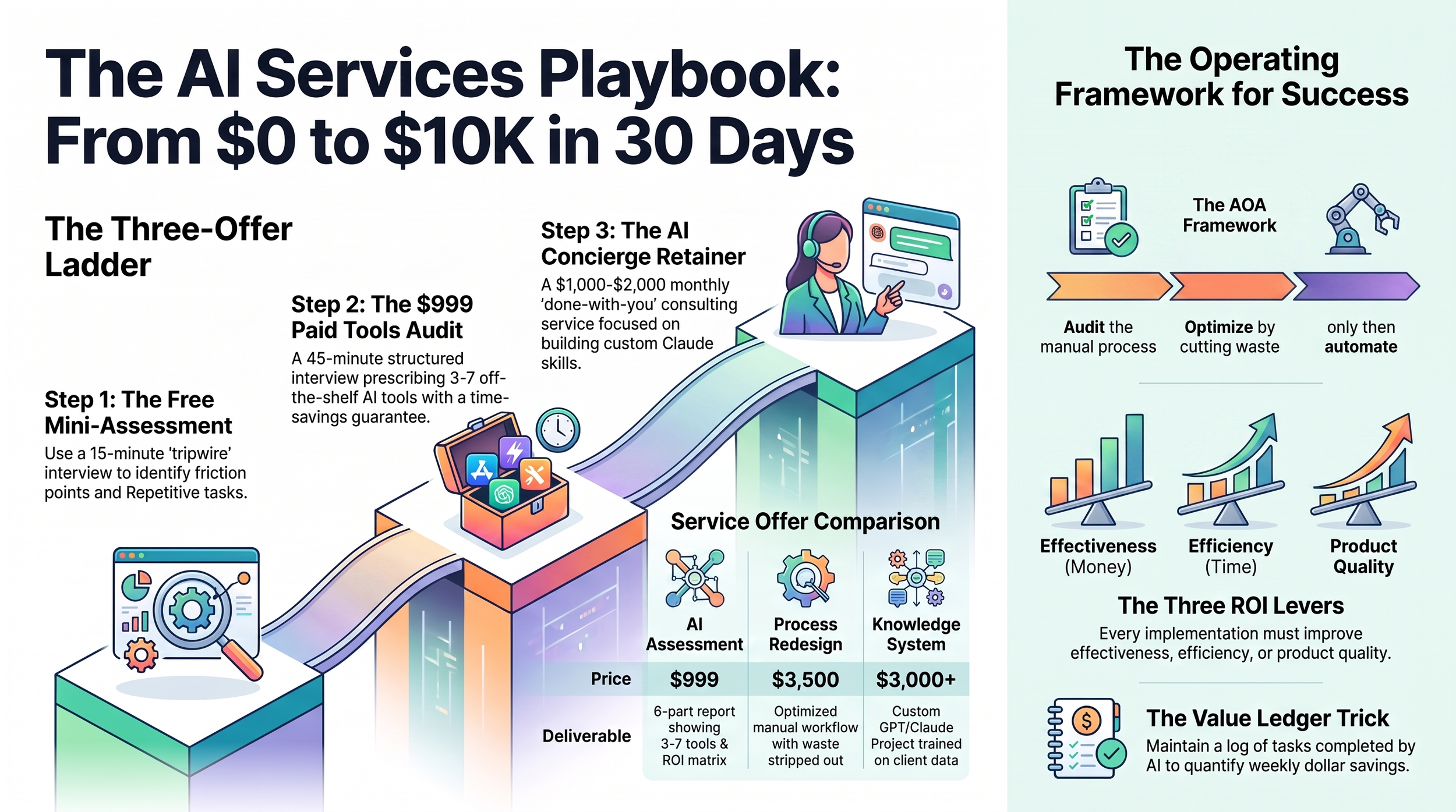
The most repeated operating rule of the week was the AOA Framework: audit the manual waste, optimize the process, and only then automate it. Automating a broken process doesn't fix it. It just makes it fail faster and locks the failure in.
One benchmark stuck: cut a 25-step process down to 10 before a single tool touches it.
Every AI project should also pull at least one of three levers, measurably:
Effectiveness: does it generate revenue?
Efficiency: does it give the team time back?
Quality: does it improve the customer experience?
If a proposed solution doesn't move one of those, it's a distraction from enterprise value.
3. The AI services offer ladder that converts
For anyone selling AI services to small businesses, last week's episodes laid out a four-rung offer ladder built to reverse risk and earn trust step by step:
Free Mini Assessment ($0): a 15-minute diagnostic built around one "magic wand" question to surface the highest-value friction point.
AI Tools Assessment ($999): a 45-minute structured interview that prescribes 3–7 tools, backed by a guarantee to reclaim five or more hours a week.
AI Concierge Retainer ($1,000–$2,000/month): two done-with-you sessions a month plus async access, so the client actually keeps using what was built.
Full Implementation ($5,000–$10,000+): process redesign, custom AI skills, and knowledge-system integration.
The conversion benchmarks shared: 30–50% from free assessment to paid audit, and 50–60% from paid audit to implementation. And a pricing rule worth noting: keep the paid assessment at the $999 floor. Pricing it lower removes the client's skin in the game and lowers follow-through.
The retainer rung exists for a reason guests called "infrastructure abandonment." Hand an owner a tool they don't know how to prompt, and they'll quietly stop using it and then churn. One tactic to prevent it: a three-way group chat between the client, the account manager, and the AI agent, so the client learns by watching real-time coaching.
4. Simple unit economics scale
The standout growth story of the week was fragrance brand Dossier, which went from a Brooklyn basement to a top seller at Walmart and roughly $150M in sales by delivering premium-quality scents at an accessible price.
The operating lesson was a single-component strategy: one bottle, one pump, and one cap across every product. That simplicity cut supply-chain complexity and protected the margins needed to fund quality ingredients and retail expansion. Guests also described treating customer acquisition cost like rent: a recurring cost of occupying digital shelf space that only makes sense if order value and margin can cover it.
5. Revenue is not cash
The most sobering number of the week: even with sales at that scale, Dossier reportedly got down to $33 in the bank four days before payroll. Wholesale growth comes with Net-30, Net-60, and even Net-75 payment terms, and rapid retail expansion can open a liquidity gap that growth alone won't close.
The takeaway for any owner scaling into bigger accounts: model the payment terms before you sign the deal, and track cash position as closely as you track sales.
Did you know you can ask our agent for AI help? Ask our website agent for ‘AI Help’
The "stop doing this" list
Four traps last week's guests want out of your business:
Automating broken processes. Redesign first; automate second.
Handing off tools without coaching. If the client can't use it, they will churn.
Using DTC packaging on a retail shelf. Packaging built for a website often fails in a store. Redesign it to sell physically.
Pricing assessments under $1,000. Low prices lower commitment and implementation rates.
The metrics that matter this week
The value ledger: a weekly log of time and money saved for each client. One example cited: 63 hours and $6,300 saved in a single week for one client.
CAC-as-rent: does your order value and margin support what it costs to acquire a customer?
Return rate: under 5% for high-friction categories, supported by trial-friendly policies.
Service conversion: 30–50% free-to-paid assessment, 50–60% paid assessment to implementation.
Cash runway vs. payment terms: log Net terms and cash position daily when scaling into wholesale.
That first metric is worth an honest look. If you can't show a client, in writing, what you saved them this week, your retainer is living on goodwill rather than proof.
Quick quiz: did the briefing stick?
Q: What is GEO? A: Generative Engine Optimization: structuring content so AI tools like ChatGPT, Gemini, and Perplexity cite your business in their answers.
Q: What does the AOA Framework stand for? A: Audit, Optimize, Automate. Remove waste and redesign the process before you automate it.
Q: What are the three ROI levers every AI project should move? A: Effectiveness (revenue), Efficiency (time reclaimed), and Quality (customer experience).
Q: What conversion rates were cited for the AI services offer ladder? A: 30–50% from free assessment to paid audit, and 50–60% from paid audit to full implementation.
Q: What is "infrastructure abandonment"? A: When a client is handed an AI tool without ongoing coaching, stops using it, and churns.
Q: What was Dossier's single-component strategy? A: Using one bottle, pump, and cap design across every product to simplify the supply chain and protect margins.
The bottom line
Last week's message was consistent across every show: get cited where buyers now ask their questions, fix the process before you automate it, and never confuse sales with cash in the bank.
DECK DOWNLOAD: "Download the briefing deck (PDF)" → M1361 - SMB - Slide Deck (Aug 3–9, 2026).pdf