

AI-First, Not AI-Only: What Last Week's Top CX Podcasts Said About Earning Back Customer Trust
Five takeaways from last week's top customer experience podcasts: goal mapping, the "ask once" promise, the microwave test for AI, and designing for the edges.
A customer calls about a billing error. She explains it to the chatbot, then to the first agent, then to a supervisor, then to "the right department." By the fourth retelling, the refund barely matters. What she remembers is that nobody owned her problem.
Did you know you can ask our agent for CX help? Ask our website agent for ‘CX Help’
That call is a small version of the biggest theme in last week's customer experience podcasts (August 3–9): customers don't experience your departments; they experience your promise. Guests pointed out that the American Customer Satisfaction Index has been essentially flat since 2013, despite enormous investment in CX technology. This briefing synthesizes 24 episodes published across the week; here's what the sharpest CX leaders said about why, and what to change.
1. Map the customer's goal before you map your process
Journey maps document what the company does. Last week's guests argued for goal mapping instead: name exactly what the customer needs to achieve, then design every internal step around getting them there.
The metric that goes with it is Service Functionality Days, the number of days the product or service is actually working for the customer. It replaces siloed departmental output (tickets closed, units shipped) with one shared outcome the whole company can rally around.
2. Make the "ask once" promise
Every transfer forces the customer to relive the problem, and every retelling raises churn risk. The fix guests kept returning to: whoever receives the complaint owns it until it's resolved.
Two practices make that promise realistic:
A published pre-approved action list. Document the waivers, credits, and replacements frontline staff can grant on first contact, without routing to a manager.
Treating recovery as an opportunity. The service recovery paradox holds that a failure handled quickly and with real empathy can leave a customer more loyal than if nothing had gone wrong.
3. Use AI for the peas, not the steak
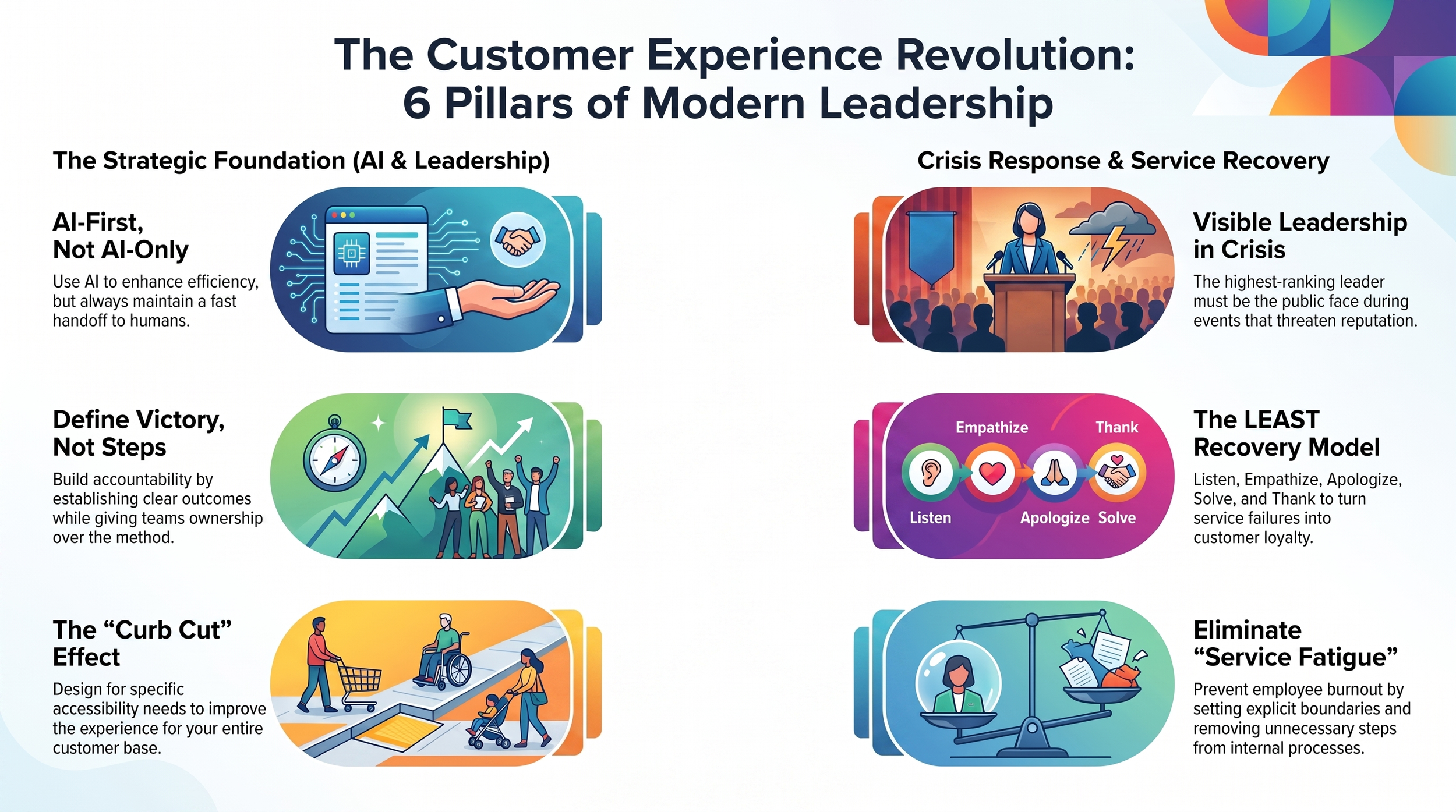
The most memorable framework of the week was the microwave test. A microwave is great for peas and terrible for steak. AI is the same: excellent for repetitive, simple, high-volume work, and a poor fit for complex, emotionally loaded conversations.
Guests drew a sharp line between two approaches:
AI-First: AI accelerates the customer's goal, and a fast, transparent path to a human is always there.
AI-Only: automation bolted on to keep up, with dead-end loops and no human safety net.
The cost of getting it wrong is trust. Once customers feel they have to double-check what the AI told them, the experience stops being a differentiator and becomes a commodity.
4. Design for the edges
Designing for the "average customer" was called out as a fallacy, because that customer doesn't exist. Guests pointed instead to the curb cut effect: sidewalk ramps built for wheelchair users turned out to help parents with strollers, travelers with luggage, and delivery workers too.
The CX version: solve for customers with limited mobility, limited time, or high cognitive load, and you simplify the experience for everyone. Inclusive design, in this framing, is an innovation driver, not a compliance box.
5. Let judgment beat policy
The most human story of the week: a salon charged a missed-appointment fee to a client whose husband had just died unexpectedly. The policy was followed. The relationship was lost.
The lesson is that policies should guide staff, not replace their judgment. Guests offered a simple check for every fee, contract term, and rule: the "make mom proud" test. If you wouldn't apply it to your own parent, rewrite it.
The same principle applies inside the team. Define what victory looks like, then let employees own the method, rather than dictating every step.
Did you know you can ask our agent for Ai help? Ask our website agent for ‘Ai Help’
The "stop doing this" list
Five habits last week's guests want out of your service playbook:
Hiding behind policy. Give staff room to recognize real exceptions.
Micromanaging. Handing over the solution before people can think it through kills ownership.
Designing for the average customer. Build for the edges and everyone benefits.
Blurry availability. Unclear hours create service fatigue for customers and burnout for staff. Set explicit boundaries.
Making customers retell their story. Whoever takes the complaint owns it.
The metrics that matter this week
Service Functionality Days: how many days your product is fully working for the customer.
First-contact autonomy rate: the share of issues resolved without manager routing.
Small-friction wins: one cosmetics company improved conversion at zero cost simply by removing unnecessary intake form fields.
Structured recovery (LEAST): Listen, Empathize, Apologize, Solve, Thank — with the reminder to "listen like you're wrong."
That third item is the easiest place to start. Pick one intake form this month and delete every field that doesn't change the outcome for the customer.
Quick quiz: did the briefing stick?
Q: What is the difference between journey mapping and goal mapping? A: Journey mapping documents what the company does; goal mapping names what the customer must achieve and designs the process around it.
Q: What are Service Functionality Days? A: The number of days a product or service is fully working for the customer, used as a shared company-wide outcome metric.
Q: What is the "ask once" promise? A: Whoever receives a customer's complaint owns it through resolution, so the customer never has to retell the story.
Q: What is the microwave test for AI? A: Use AI for "the peas" (simple, repetitive tasks) and keep humans on "the steak" (complex, emotional interactions).
Q: What is the curb cut effect in CX? A: Solving for customers with specific accessibility needs ends up simplifying the experience for everyone.
Q: What does LEAST stand for? A: Listen, Empathize, Apologize, Solve, Thank.
The bottom line
Last week's message was consistent across every show: measure what the customer achieves, let one person own each problem, and use AI to speed people up rather than wall them off.