

Count Particles, Not Cholesterol: What Last Week's Top Health Podcasts Said About Executive Longevity
Five takeaways from last week's top health podcasts for busy executives: LDL particle count and ApoB, gut mitochondria, advanced biomarkers, and smarter recovery.
A CEO gets her annual physical results back. Cholesterol: normal. She files the report and gets back to the quarter. According to several of last week's guests, that "normal" result may have left out the number that matters most.
Did you know you can ask our agent for Sales help? Ask our website agent for ‘Sales Help’
That gap captures the biggest theme in last week's health and wellness podcasts (August 3–9): the standard tests are measuring the wrong things. For leaders who treat their health as a return on investment, better data now comes before any new protocol. This briefing synthesizes 164 episodes published across the week; here's what the sharpest voices said, distilled for busy executives.
1. Count the particles, not just the cholesterol
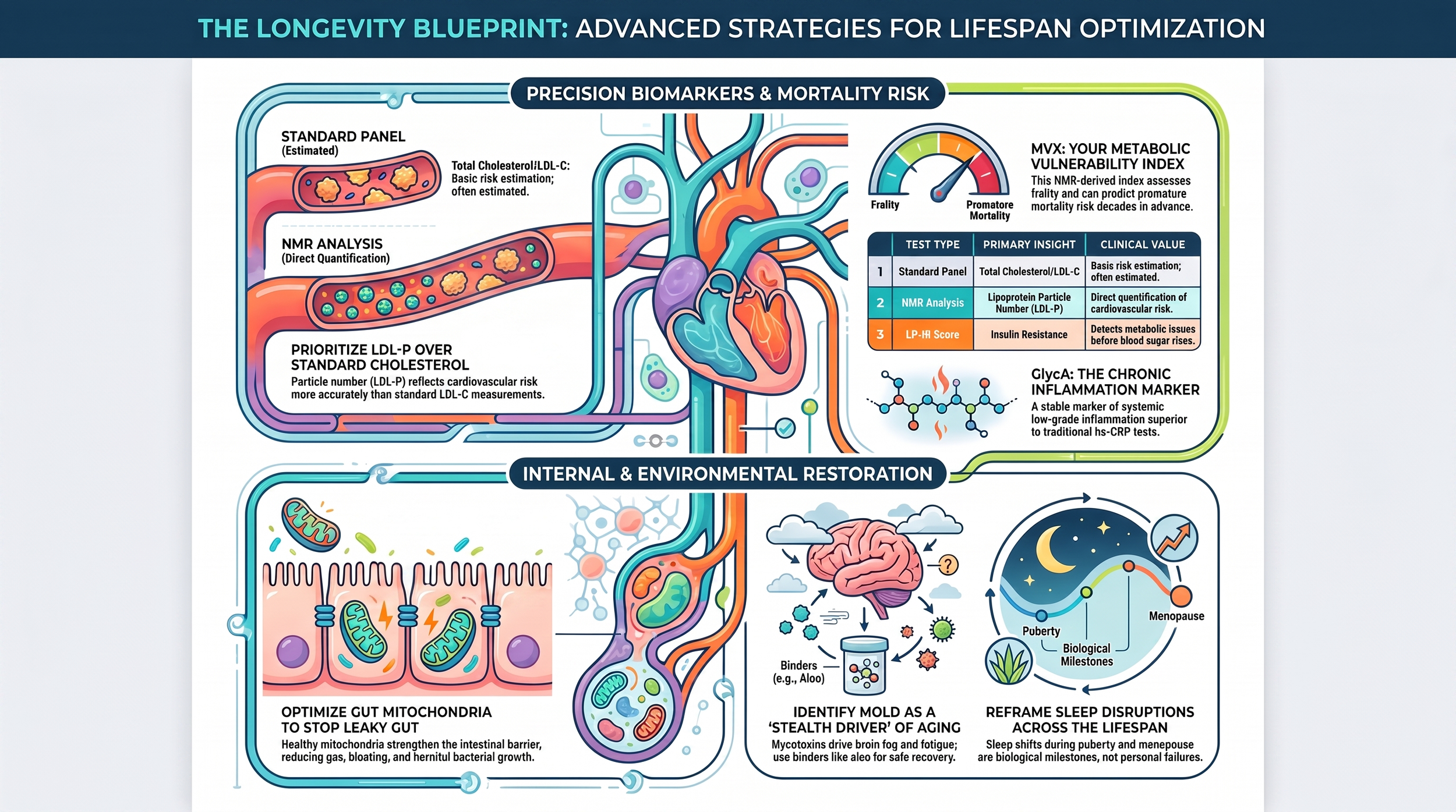
The loudest consensus of the week: LDL particle number (LDL-P) and ApoB are better predictors of cardiovascular risk than a standard LDL cholesterol reading. Guests stressed that particle size doesn't provide the reassurance many people assume. A high number of "large, fluffy" particles can still drive plaque.
The practical point for executives: a basic lipid panel can offer false comfort. Guests recommended asking about NMR lipoprofile testing (which reports LDL-P) and ApoB as a separate, confirming measure.
2. Your gut runs on mitochondria
A newer idea that got serious airtime: the mitochondria in your intestinal lining help keep the gut barrier intact and shape which bacteria thrive there. When those mitochondria struggle, guests described an "oxygen leak" into a normally low-oxygen environment, which lets less friendly bacteria take hold.
They also described a helpful loop: healthy gut mitochondria support bacteria that produce butyrate, and butyrate in turn fuels those mitochondria. Supplements discussed in this context included tributyrin (a form of butyrate), urolithin A (studied for its role in clearing out damaged mitochondria), and immunoglobulins for gut barrier support. For a leader fighting chronic fatigue or inflammation, the message was that gut energy is worth a conversation with your doctor.
3. Advanced biomarkers can see trouble years early
Guests highlighted a group of NMR-derived markers that go well beyond a standard panel:
LP-IR score: can flag insulin resistance years before fasting glucose or A1C rise.
GlycA: described as a more stable measure of chronic, low-grade inflammation than hs-CRP.
Metabolic Vulnerability Index (MVX): used to assess metabolic frailty and resilience, including recovery ahead of surgery.
The framing that resonated: these tests work like an early-warning system for your highest-output years, giving you time to act before a problem shows up on a routine lab.
4. Recovery that actually works under pressure
For leaders carrying heavy stress loads, three recovery points stood out:
CBT-I (Cognitive Behavioral Therapy for Insomnia) was named the clinical gold standard for chronic sleep problems.
Electrolytes matter. Guests connected the "wired and tired" feeling, especially during intermittent fasting, to low sodium, potassium, and magnesium.
Stealth mold exposure was raised as an overlooked cause of persistent brain fog. If you don't respond to standard recovery protocols, guests suggested asking your medical team about mycotoxin screening, such as visual contrast sensitivity testing and exposure questionnaires.
5. Protect focus with the right inputs
On cognitive performance, guests discussed Lion's Mane mushroom for its link to nerve growth factor, which plays a role in memory and focus, and emphasized choosing well-formulated, well-absorbed products. The broader point was consistent with the rest of the week: solve for the hidden drains on your brain (poor sleep, inflammation, environmental exposure) before stacking new supplements on top.
Did you know you can ask our agent for Sales help? Ask our website agent for ‘Sales Help’
The "stop doing this" list
Three habits last week's guests want you to rethink:
Assuming "large, fluffy" LDL is harmless. Particle count matters regardless of size.
Jumping into a mold detox first. Guests stressed removing the exposure and remediating the environment before any detox protocol.
Filling your calendar with "catch-up" calls. Swap administrative recap calls for shorter, real-time, higher-value conversations. Your energy is a resource too.
The metrics that matter this week
Questions worth bringing to your next physician visit:
LDL-P (via NMR): what's my particle number, not just my LDL-C?
ApoB: does it confirm the particle picture?
LP-IR: is there early insulin resistance my A1C isn't showing yet?
GlycA: what does my chronic inflammation look like?
MVX: how resilient am I metabolically, especially before a procedure?
The first question is the simplest place to start. If your last panel only showed total cholesterol and LDL-C, ask whether particle testing makes sense for you.
Quick quiz: did the briefing stick?
Q: Why did guests say LDL-P and ApoB matter more than standard LDL cholesterol? They measure the number of atherogenic particles, which guests described as a better predictor of cardiovascular risk than cholesterol concentration.
Q: Does particle size make LDL less risky? A: According to last week's guests, no. A high number of particles drives risk regardless of size.
Q: What is the gut "oxygen leak"? A: When intestinal mitochondria struggle, oxygen enters a normally low-oxygen gut environment and allows less beneficial bacteria to thrive.
Q: What does the LP-IR score detect? A: Insulin resistance, potentially years before fasting glucose or A1C rise.
Q: What is CBT-I? A: Cognitive Behavioral Therapy for Insomnia, described as the clinical gold standard for chronic sleep problems.
Q: What should come before a mold detox? A: Removing the exposure and professionally remediating the environment.
The bottom line
Last week's message was consistent across every show: get better data before chasing new protocols, look after the gut as an energy system, and treat recovery as part of performance, not a break from it.